Calanais Stones / Tursachan Chalanais

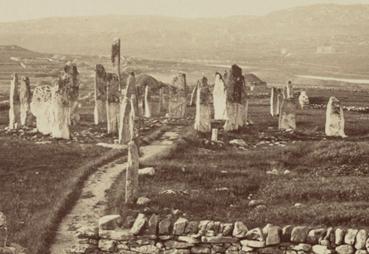
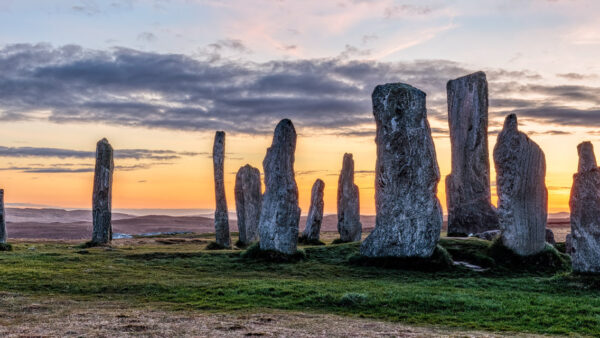
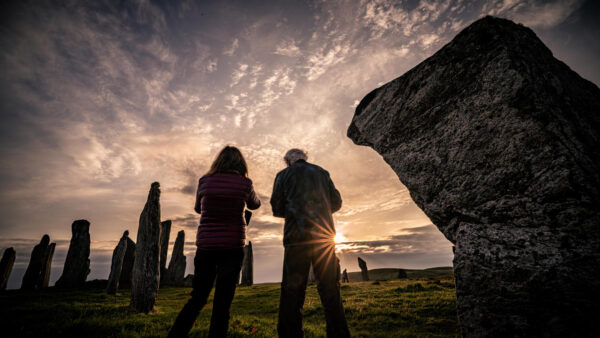
The Calanais Stones (sometimes referred to as Calanais I) stand as one of Scotland’s most significant prehistoric monuments. Located on the west coast of the Isle of Lewis in the Outer Hebrides, just 13 miles due west of Stornoway, the stones are positioned on a prominent ridge on a peninsula jutting into Loch Roag. This elevated location ensures they are silhouetted against the sky, making them visible from far and wide.
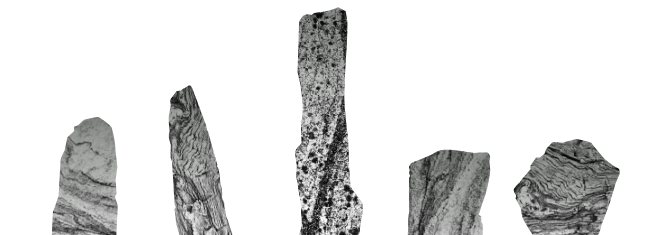
Built from ancient Lewisian Gneiss, these are among the oldest exposed rocks in the world. The stone circle dates to approximately c 2900BC, placing it firmly in the Neolithic period.
When viewed from above, the Calanais Stones form a Celtic cross-shaped pattern, which sets them apart from many other British stone circles.
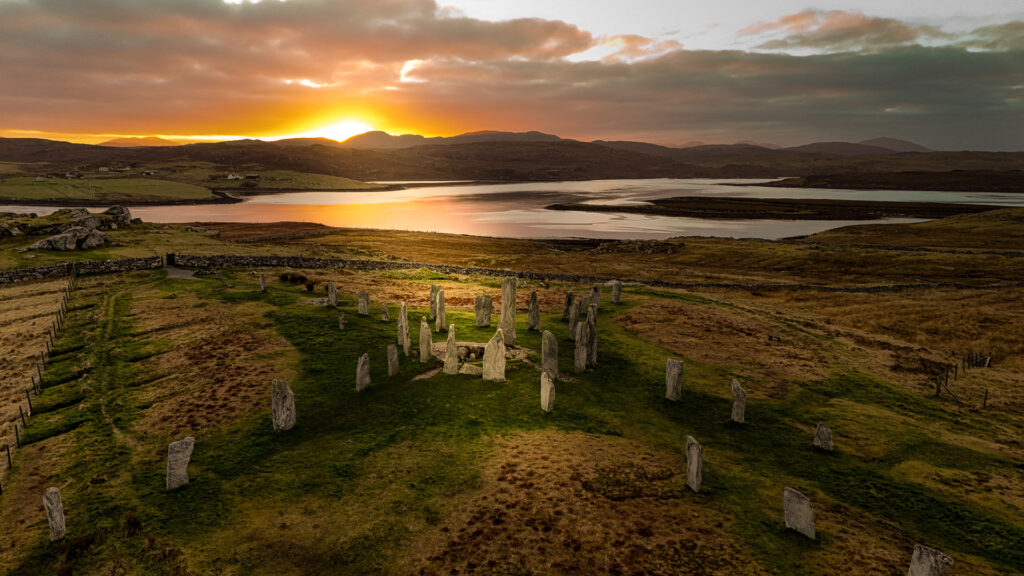
There are 13 stones in the main circle, plus the tall, central monolith standing at 4.8m / 16ft high. At the foot of this huge stone lies a small, chambered cairn, once used to house the dead. To the north of the main circle is an avenue with 19 surviving stones in a double row. To the east, south and west are shorter arms with 5, 5, and 4 stones respectively.
Cnoc an Tursa
When visiting Calanais I, you will see a low natural hill just outside the main stone circle site. Its name comes from Scottish Gaelic, ‘cnoc’ which means hill and ‘an Tursa’ meaning of sorrow/mourning. Only a short walk from the Calanais Stones, Cnoc an Tursa is a significant site. It offers a raised viewpoint over the main Calanais Stones site and out over Loch Roag.
Note: More detailed information will soon be provided in the Research Hub that Urras nan Tursachan are developing to complement this website. You can also find detailed archaeological facts on Calanais I and other stone circle sites in the Canmore website and in Patrick Ashmore’s excavation report.